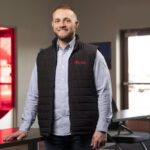

Tom Bahr
PrincipalBSATom leads multidisciplinary teams on projects with a commitment to building resiliency and human-centered design. In his twenty years of experience delivering healing environments, he has worked on everything from large urban hospital campus renewals to rural critical access hospitals. Tom focuses on building strong, collaborative partnerships, and his work emphasizes aligning business cases, facility performance, and patient‑centered outcomes. Tom engages in the healthcare design community outside of work serving as Co-Chair of the AIA AAH Webinar Committee and member of the AMFP Greater St. Louis Strategic Alliances Committee. Tom holds a Bachelor of Architecture from Drury University.
E52 – Built to Flex: Using Prototype Modules to Future-Proof Ambulatory Clinic
As ambulatory care delivery evolves, healthcare systems must design clinic environments that adapt to shifting specialties, care models, and operation…As ambulatory care delivery evolves, healthcare systems must design clinic environments that adapt to shifting specialties, care models, and operational demands without repeated renovation. Houston Methodist’s new Cinco Ranch and Spring Comprehensive…As ambulatory care delivery evolves, healthcare systems must design clinic environments that adapt to shifting specialties, care models, and operational demands without repeated renovation. Houston Methodist’s new Cinco Ranch and Spring Comprehensive Care Center models were developed as part of a systemwide ambulatory strategy in partnership with BSA, using prototype clinic modules as the primary mechanism for embedding flexibility into the built…As ambulatory care delivery evolves, healthcare systems must design clinic environments that adapt to shifting specialties, care models, and operational demands without repeated renovation. Houston Methodist’s new Cinco Ranch and Spring Comprehensive Care Center models were developed as part of a systemwide ambulatory strategy in partnership with BSA, using prototype clinic modules as the primary mechanism for embedding flexibility into the built environment. The modular framework established a consistent planning logic for exam rooms, team work areas, shared support spaces, and circulation, while allowing clinics to flex by specialty, staffing model, and patient volume. Modules were intentionally designed to support multiple scenarios, enabling clinics to transition over time with minimal physical modification. Simulation modeling, full-scale mockups, and stakeholder engagement were used to test performance under varying operational conditions, including peak volumes, cross-coverage staffing, and vertical stacking. Deploying the modular strategy across both projects revealed critical lessons, including aligning module dimensions with staffing ratios, strategically locating shared support spaces, and balancing standardization with targeted customization. This session shares practical insights into designing, testing, and refining clinic modules as adaptable systems, offering transferable strategies that support long-term flexibility, operational resilience, and consistent, safe performance across ambulatory environments. Show MoreClick the title to see all detailsShow More




E85 – Design-Build + Target Value Delivery: A Lifeline for Rural Healthcare in Times of Uncertainty
Rural hospitals face escalating pressures that directly affect the health, safety, and welfare of patients, staff, and surrounding communities. Accele…Rural hospitals face escalating pressures that directly affect the health, safety, and welfare of patients, staff, and surrounding communities. Accelerated construction cost escalation, inflation-driven material and labor volatility, evolving federal…Rural hospitals face escalating pressures that directly affect the health, safety, and welfare of patients, staff, and surrounding communities. Accelerated construction cost escalation, inflation-driven material and labor volatility, evolving federal funding conditions, and workforce shortages place critical healthcare capital projects at heightened risk—often threatening clinical functionality, patient safety, and equitable access to care. This …Rural hospitals face escalating pressures that directly affect the health, safety, and welfare of patients, staff, and surrounding communities. Accelerated construction cost escalation, inflation-driven material and labor volatility, evolving federal funding conditions, and workforce shortages place critical healthcare capital projects at heightened risk—often threatening clinical functionality, patient safety, and equitable access to care. This session examines how an integrated Design-Build + Target Value Delivery (TVD) approach supports safer, more resilient rural healthcare environments by enabling informed decision-making, cost predictability, and risk mitigation throughout planning, design, and preconstruction. Using the Hillsboro Health Surgery, Entrance, and Central Utility Plant (CUP) project as a case study, presenters from BSA LifeStructures, O’Shea Builders, and Hillsboro Health will demonstrate how early interdisciplinary teaming, continuous cost modeling, and scope–value alignment preserved critical clinical requirements while responding to market uncertainty. Attendees will gain actionable strategies for aligning project scope and budgets with patient safety, operational continuity, and long-term community well-being. The session highlights delivery methods that reduce owner risk, support equitable access to healthcare facilities, and strengthen the resilience of rural hospitals serving vulnerable populations.Show MoreClick the title to see all detailsShow More